Why Do Sports Have to Be Competitive?
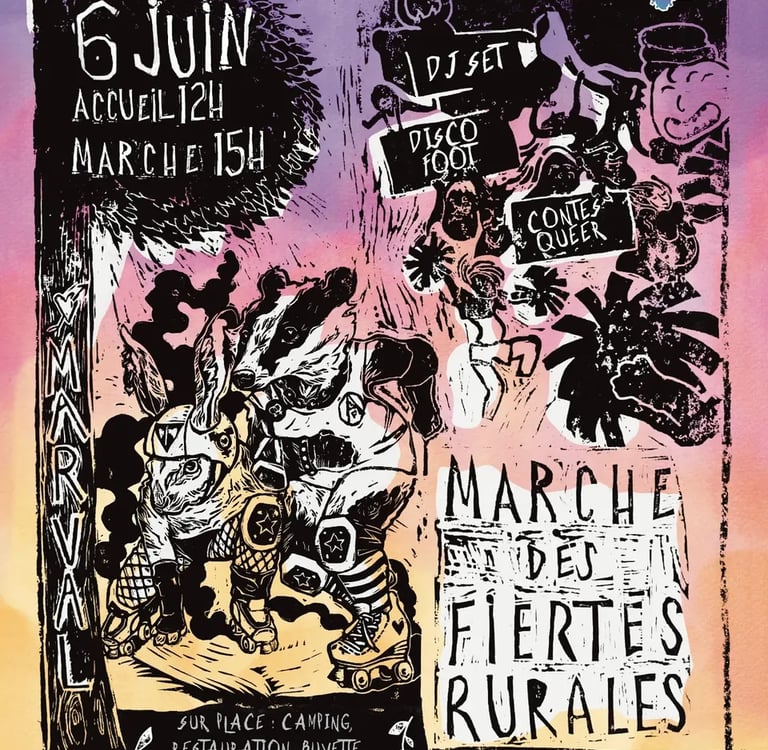
This article was written for a fanzine dedicated to the theme “Sport and Queerness,” a project led by the Fière des Champs association, which is organizing Pride des Champs 2026 in the village of Marval. The fanzine will be distributed there.
VALUESSTORIES
Mark
6/2/20263 min temps de lecture

Why Do Sports Have to Be Competitive?
Nobody taught me the concept of non-competitiveness. I didn't even know it existed until recently. But looking back, I think I always felt it — a discomfort with the whole structure of organised sport, the way it funnelled something that could be joyful and free into a system designed, ultimately, to produce losers.
Because that's what competition does. For every winner, there are many who didn't win. We're told the important thing is to participate, but that's a consolation that also serves the machine — without competitors, there is no competition. Participation is the fuel. The playfulness gets burned off, and what's left is tension, comparison, sometimes violence, and a particular kind of shame that sport seems very good at generating.
I was always looking for something else. Games that were just fun, that were mindful, played with care and respect, without anyone keeping score.
Even the gym, where I went mostly to cruise rather than work out, felt hostile to ease. The bodies there were worked with such vanity that it became its own competition — not against others exactly, but against some imagined ideal self in the mirror. A different kind of losing.
So it won't surprise anyone that I gravitated towards group classes, towards movement that was the least violent and most alive. On my own I would cycle — as transport, not sport — swim, because water always felt like home, and dance, because moving my body to music needed no justification beyond pleasure.
Then, in my mid-thirties, with a life hygiene that was frankly not wonderful, I woke up one morning unable to get out of bed. A herniated disk. The pain was clarifying.
A friend suggested yoga to correct my posture. I was sceptical. Yoga seemed reserved for women, for flexible people, for mystics — none of which I felt I was. But I took private sessions, and something unexpected happened: I discovered what posture actually was. How I inhabited my body. How in every sport I had ever practised, this had barely been mentioned — and how that absence, combined with competitive pressure to push harder and faster, made injury not a risk but almost an inevitability.
That question — is sport actually making us well? — didn't leave me. And it pulled me deeper into yoga, not as exercise but as inquiry. It took years of practice and study, including time in India, before I began to understand it as what it actually is: a holistic system of health, one that addresses the body, the breath, the mind and one's relationship to the world, all at once. Eventually, almost without intending to, I became a teacher.
What I knew was that I didn't want to teach in the mainstream. I wanted to teach within and for my community. And what made most sense to me at the time was to teach men — naked men. I can already hear the objection: in a world shaped by patriarchy, why centre men again? My answer is that yoga, in its gentleness and its attention to the inner life, sits quite outside the patriarchal tradition, and that many men are quietly intimidated by yoga spaces that are predominantly female. As for the nakedness — yoga philosophy and its history have always had a deep relationship with simplicity, with nature, with the body unadorned. Naked practice is not transgression. It's quite old.
My own path — from Paris to India and eventually to the French countryside — led me to something I hadn't planned: a queer ashram I named Fantasy Farm. Part of what made this possible was discovering the Radical Faerie movement, and particularly its invitation to find one's nature in nature. The Faeries also widened my understanding of what the queer community contains: the full range of gender possibilities, the importance of chosen mixity, and the equal importance of non-mixed safe spaces where particular people can arrive without having to explain themselves.
All of this shapes what Fantasy Farm tries to be. A place built around yoga and touch, yes — but more fundamentally, a place built on the conviction that we can only truly inhabit our bodies, trust them, and work with them, within a space that feels genuinely safe. The competitive body — performed, ranked, reflected in mirrors — is a body under threat. What I'm interested in is the other possibility: the body at play, at rest, at home in itself, in the company of others who are trying to do the same thing.